HUMANITY FILES
Nagasaki
The second atomic bombing, three days after Hiroshima
Nagasaki · 9 August 1945
Summary
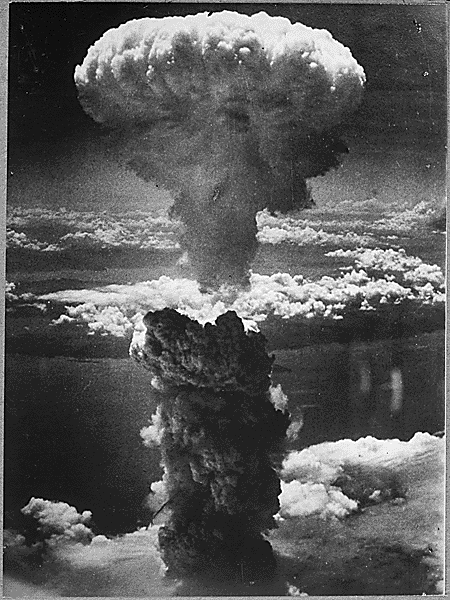
At 11:02 a.m. on 9 August 1945, three days after Hiroshima, a U.S. B-29 named Bockscar dropped a plutonium implosion bomb known as Fat Man over Nagasaki. The mission had originally aimed at Kokura, but visibility problems led the crew to proceed to its secondary target. Nagasaki was an important industrial port with major Mitsubishi shipbuilding and arms facilities. It was also a city of families, schools, hospitals, churches, neighbourhoods, conscripted and forced workers, and prisoners of war. The bomb detonated over the Urakami Valley. Nagasaki City's historical records give a figure of 73,884 dead and 74,909 injured, while other institutional histories commonly round the death toll by the end of 1945 to roughly 70,000–75,000. Nagasaki raises an especially difficult historical question because it was the second atomic bombing: historians debate not only whether atomic bombing was necessary in general, but whether the second bomb was necessary when and where it was used, and whether Japanese decision-makers had enough time to comprehend Hiroshima before the second attack.
Estimated Impact
Nagasaki City's historical chronology records 73,884 deaths, 74,909 injured, and 120,820 people affected — a named municipal figure, not treated here as a universally exact count.
Destruction of records, wartime movement of people, later radiation-related deaths, and differences in cutoff dates all complicate reconstruction of an exact total; other institutional histories commonly round the death toll by the end of 1945 to roughly 70,000–75,000.
Before the Event
By August 1945, Nagasaki was a significant industrial centre. Its shipyards and arms works supported Japan’s war effort. But, like most industrial cities, military production existed alongside dense civilian life.
The U.S. atomic-bomb program had two different weapon designs ready for combat use. Hiroshima’s Little Boy used uranium. Fat Man used a more complex plutonium implosion design related to the device tested at Trinity.
On 8 August Moscow time, the Soviet Union declared war on Japan, ending the Soviet-Japanese Neutrality Pact in practice and opening a new front. Soviet forces moved into Manchuria. This destroyed Japanese hopes that Moscow might mediate more favourable surrender terms and intensified the crisis inside Tokyo’s leadership.[1]
What Happened
The 9 August mission initially targeted Kokura. Cloud, smoke and visibility problems prevented the crew from obtaining the required aiming conditions. Fuel constraints became increasingly serious, and the aircraft moved to Nagasaki, the secondary target.
At 11:02 a.m., Fat Man detonated over the Urakami district. Nagasaki’s hilly geography limited some of the blast’s reach compared with what a similar explosion might have done over flatter terrain, but the Urakami Valley itself was devastated.
Homes, factories, schools, medical facilities and religious buildings were destroyed or severely damaged. Urakami Cathedral, one of East Asia’s largest Christian churches, stood close to the hypocentre and was destroyed. Medical personnel and patients were killed, sharply reducing the city’s ability to respond.
As at Hiroshima, survivors faced blast trauma, burns, fire and radiation exposure. Acute radiation sickness emerged among some survivors in the following days and weeks.
Who Was Affected
Nagasaki’s victims included civilians and workers in military-related industries, children, medical staff, religious communities, Korean and Chinese labourers, and Allied prisoners of war in the wider Nagasaki area.
The city’s history also complicates simple categories of “enemy” and “civilian.” Some residents worked directly in war production; others were family members living around industrial zones; some colonial and foreign labourers had little control over their presence there.
Deaths and Casualty Estimates
Nagasaki City records 73,884 deaths, 74,909 people injured, and 120,820 people affected in its historical chronology.[4]
As with Hiroshima, the figure should not be treated as mathematically exact. Destruction of records, movement of people, later radiation-related deaths and differences in cutoff dates complicate reconstruction.
A defensible Humanity Files formulation is:
Approximately 74,000 people were recorded as dead in Nagasaki’s post-bombing municipal estimate, with substantial uncertainty in any exact total.
The Official Justification
The U.S. government understood the atomic bombs as operational military weapons intended to accelerate surrender. Truman’s 6 August statement had publicly warned Japan that further destructive power would be used if surrender did not follow.[2]
The second bombing, however, presents a distinct question from the first. It occurred only three days after Hiroshima and on the same day that Japan’s leadership was absorbing the Soviet attack. Later debate has therefore focused on timing: was a second nuclear attack required to demonstrate that Hiroshima was not a one-off capability, or did events move too quickly for Japanese leaders to fully process the first bombing and the Soviet offensive?
The historical record confirms that surrender discussions intensified dramatically on 9 August. It does not provide a simple experimental answer to what Japan would have done if Nagasaki had not been bombed.
What the Evidence Shows
Well Established
- Nagasaki was the secondary target after the mission failed to attack Kokura.
- Fat Man detonated over Nagasaki at 11:02 a.m. on 9 August 1945.[4]
- Nagasaki contained important military-industrial facilities and a large civilian population.
- The Soviet Union entered the war against Japan in the same critical period.[1]
- The bombing caused mass death through blast, heat, fire and radiation.
Strongly Supported
- The bomb intensified an already acute surrender crisis in Tokyo.
- The combination of Hiroshima, Soviet entry and Nagasaki placed Japanese leaders under extraordinary pressure.
- Nagasaki’s topography shaped the pattern of destruction.
Uncertain or Disputed
- Whether Nagasaki was necessary to compel surrender.
- Whether three days gave Japan adequate time to understand Hiroshima and formulate a response.
- Whether the second bomb was driven more by military planning, strategic signalling, momentum in an approved operational process, or some combination.
- How much independent causal weight should be assigned to Nagasaki versus Soviet entry.
Historical Debate
The most important distinction is between sequence and causation.
The sequence is clear: Hiroshima was bombed on 6 August; the Soviet Union entered the war against Japan in the following days; Nagasaki was bombed on 9 August; Japan’s leadership entered decisive surrender deliberations; the Emperor intervened to break political deadlock; surrender followed.
Causation is harder. Some historians argue that two atomic attacks demonstrated an ability to continue destroying Japanese cities and broke resistance. Others emphasize the Soviet invasion as strategically devastating because it removed the possibility of Moscow serving as an intermediary and threatened Japan from another direction. Others treat the events as cumulative rather than competitive explanations.
A U.S. diplomatic record of Japanese surrender discussions created after the war described the atomic bomb and Soviet entry as developments that the Japanese prime minister could use to push the leadership toward ending the war.[3] Because the document is retrospective, it should be used carefully, but it illustrates why a one-factor explanation is inadequate.
Human Consequences
The human consequences were immediate and long-lived. The bombing destroyed homes and workplaces, killed family groups, overwhelmed surviving medical capacity and created a population exposed to ionizing radiation.
Nagasaki’s Catholic community suffered particularly visible destruction in Urakami. Korean and Chinese workers were among the dead and injured. Allied prisoners were also caught within the wider disaster.
Survivors, like those in Hiroshima, later faced health anxiety and social stigma in addition to bereavement and physical injury.
Accountability and Recognition
No criminal prosecution was brought against U.S. leaders or aircrew for the atomic bombing. The historical reckoning occurred instead through survivor testimony, scholarship, memorialization, diplomatic debate and nuclear-disarmament movements.
Nagasaki rebuilt and developed a civic peace identity closely connected to survivor testimony and nuclear abolition. Its remembrance is often overshadowed internationally by Hiroshima, yet the second bombing raises separate moral and operational questions that should not be collapsed into a single generic “atomic bomb” narrative.
What Changed Afterwards
Nagasaki demonstrated that atomic bombing was not simply a singular event at Hiroshima. Two weapons of different designs had been used in combat within three days. The nuclear age therefore began not with a single anomaly, but with evidence that nuclear weapons could become repeatable instruments of state power.
The postwar arms race soon produced weapons thousands of times more powerful than the Nagasaki device. The logic of deterrence increasingly rested on the possibility of repeated nuclear destruction on an incomparably larger scale.
Questions That Remain
- Did Japan need to experience a second atomic bombing to accept surrender?
- How much time should have been allowed after Hiroshima before another nuclear attack?
- Could Kokura’s escape through cloud and smoke alter how we think about contingency in mass violence?
- How should military-industrial targets be assessed when they are embedded within urban civilian communities?
- Does the existence of a legitimate military objective justify a weapon whose destructive effects spread far beyond it?
Ideas Behind This File
Institutions
Sources & Evidence
Primary Sources
Agreement Regarding Entry of the Soviet Union Into the War Against Japan
Statement by the President Announcing the Use of the A-Bomb at Hiroshima
Foreign Relations of the United States: record of Japanese surrender deliberations
Retrospective postwar record describing the combined effect of atomic bombing and Soviet entry.
Official Records
Nagasaki City historical chronology, entry for 9 August 1945
Verified 2026-09-20: page records "11:02 a.m. detonation, 73,884 deaths, 74,909 injured, 120,820 affected."
Academic Research
Prompt and Utter Destruction: Truman and the Use of Atomic Bombs against Japan
Books
Downfall: The End of the Imperial Japanese Empire
Last reviewed: September 20, 2026. Found an error? See our corrections policy.